


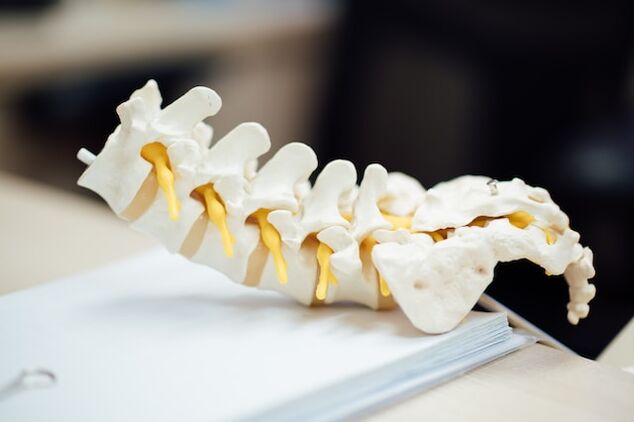
What is osteochondrosis of the spine in simple words?
Osteochondrosis of the spine is a chronic disease based on degenerative-dystrophic changes of the intervertebral disc with subsequent involvement of adjacent vertebrae, intervertebral joints and spinal ligaments in the process.
The word "osteochondrosis" has two Greek roots: οστό - bone and χόνδρος - cartilage.
Vertebrae are formations consisting of spongy bone.They are connected to each other by cartilaginous discs.There are ligaments along the front and back surfaces of the vertebrae.Cartilaginous discs prevent the fusion of the vertebrae and the dislocation of the ligaments.Thanks to the coordinated work of discs and ligaments, the spine is elastic, which allows it to perform vital functions:
- ensure balance in a vertical position,
- cushions shocks and bumps when walking and jumping,
- they protect the skull and the brain inside it from shock due to excessive shocks.
In osteochondrosis, protrusions of the intervertebral discs are formed outside the bodies of the vertebrae.Depending on the direction in which the bump appears, as well as its size, pain, numbness, muscle disorders and other symptoms develop.
ICD-10 codes:
- M42 Osteochondrosis of spine
- M42.0 Juvenile osteochondrosis of spine
- M42.1 Osteochondrosis of the spine in adults
- M42.9 Osteochondrosis of spine, unspecified
- M43.1 Spondylolisthesis
- M47 Spondylosis
- M47.0 Anterior spinal or vertebral artery compression syndrome
- M47.1 Other spondylosis with myelopathy
- M47.2 Other spondylosis with radiculopathy
- M48.0 Spinal stenosis
- M50.0 Damage to intervertebral disc of cervical spine with myelopathy
- M50.1 Damage to the intervertebral disc of the cervical spine with radiculopathy
- M50.2 Displacement of the intervertebral disc of the cervical spine of the second type
- M50.3 Other cervical intervertebral disc degeneration
- M51.0 Lesions of intervertebral discs of lumbar and other parts with myelopathy
- M51.1 Lesions of intervertebral discs of lumbar and other parts with radiculopathy
- M51.2 Other specified intervertebral disc displacement
- M51.3 Other specified degeneration of intervertebral disc
- M53 Other dorsopathies, not elsewhere classified
Types of osteochondrosis
Depending on which part of the spine changes occur, there are several variants of the disease:
- cervical,
- chest,
- lumbar,
- sacred,
- mixed variants (cervicothoracic, lumbosacral).
Depending on the duration of the symptoms, the disease can be:
- acute (up to 3 weeks),
- subacute (3-12 weeks),
- chronic (more than 12 weeks).
According to the dominant neurological manifestation:
- with myelopathy (spinal cord damage),
- with radiculopathy (pinched and inflamed nerve roots).
Causes of osteochondrosis
To date, there is no accurate information about the causes of osteochondrosis.
The role of genetic predisposition, mechanical damage and inflammation is recognized in the occurrence of premature wear of intervertebral discs.
Intervertebral discs do not have their own blood or lymphatic vessels.Vertebral vessels play a role in their nutrition and cleaning of harmful substances.With aging and/or exposure to harmful influences, blood and lymph flow decreases, discs receive less oxygen and nutrients, and harmful substances can accumulate in them.All this leads to gradual wear and tear.The degree and speed of disc wear increases when exposed to risk factors.
Risk factors:
- congenital anomalies of vertebrae and spinal canal;
- flat feet;
- occupational hazards (vibrations, lifting heavy loads, prolonged stay in a forced uncomfortable position, exposure to toxic substances);
- sedentary lifestyle;
- obesity;
- a diet that is not balanced in the content of proteins, fats, vitamins and minerals;
- insufficient consumption of clean water;
- smoking;
- environmental pollution.
Symptoms of osteochondrosis of the spine
Listed by frequency of occurrence:
- pain;
- reduced range of motion;
- numbness, loss of sensitivity;
- decreased muscle strength;
- dysfunction of organs whose innervation is connected to the problematic part of the spine.
Clinically significant manifestations of osteochondrosis of the spine were observed in 51 people per 1000 inhabitants.
The location of pain and other symptoms depends on the problematic part of the spine.
Cervical osteochondrosis:
- pain in arms, shoulders, neck, aggravated by turning and tilting the head;
- headaches;
- decreased muscle strength in the hand;
- noise in the head, dizziness, "floater" flash, colored spots before the eyes combined with a burning, throbbing headache (vertebral artery syndrome).
The health of the brain depends on the condition of the cervical spine, since the arteries to the brain pass through a channel formed by the processes of the vertebrae.If the lumen of the canal narrows due to osteochondrosis, the blood flow through the arteries is disrupted and the brain feels a lack of oxygen and nutrients.
Thoracic osteochondrosis:
- pain in the chest, under the shoulder blade, in the region of the heart, aggravated by turning the body, coughing, sneezing;
- dysfunction of the gallbladder, stomach, esophagus.
Lumbar and/or sacral osteochondrosis:
- pain in the lower back, back and side of the thighs;
- numbness of the toes;
- increased frequency of urination (10-12 times a day, possibly more), involuntary loss of urine during physical activity;
- sexual disorders.
Due to frequent pain, half of osteochondrosis sufferers show signs of constant emotional stress.
Stages of development and course of osteochondrosis
The initial stage of osteochondrosis is manifested by dull pain in the back or lower back that occurs during prolonged standing, after walking or running;pain in the neck, which is aggravated by turning and tilting the head.
As the pathology of the intervertebral disc(s) progresses, bulging (herniation) and, as a result, compression of the nerve root (radiculopathy) may occur.This leads to intense pain radiating to the arm or leg, muscle weakness, skin sensitivity disorders, vascular tone and function of the organs that receive innervation from the problematic part of the spine.In the most severe cases, compression of the spinal cord can occur, leading to paresis or paralysis.
Osteochondrosis is a chronic disease.After adequate treatment, remission occurs, i.e. the symptoms decrease or disappear completely.If a new protrusion of the intervertebral disc is formed, it worsens, and pain and other symptoms return again.
Diagnostics
Examination by a neurologist.
Basic instrumental research methods:
- magnetic resonance imaging (MRI),
- computed tomography (CT).
Additionally:
- spondylography (in-depth X-ray examination of the spine),
- electromyography (EMG),
- electroneuromyography (ENMG),
- bone densitometry (performed to detect osteopenia/osteoporosis).
Basic laboratory methods:
- general blood test,
- general urinalysis,
- biochemical blood test (glucose, creatinine, urea, electrolytes, bilirubin, liver and pancreatic enzymes; glycated hemoglobin, C-reactive protein),
- coagulogram.
Additionally:the concentration of calcium and phosphate in the blood.
Treatment of osteochondrosis
Conservative treatment
It is performed if the patient does not have acutely progressive neurological symptoms.
Objectives:
- reduction or relief of pain,
- correction of muscle tone,
- reduction of inflammation and swelling,
- preventing the progression of dystrophic changes in the spinal structures,
- correction of disturbed function of internal organs,
- increasing the patient's daily activity,
- teaching the patient to cope with pain.
Conservative treatment of osteochondrosis includes:
- respecting a rational motor regime,
- medication use,
- physiotherapy,
- massage,
- Exercise therapy (after pain relief and condition stabilization),
- acupuncture,
- manual therapy.
Drug treatment
The main groups of drugs that can alleviate or relieve pain and stabilize the condition of patients with osteochondrosis are listed.Only a doctor can choose an adequate treatment regimen, taking into account the characteristics of the clinical picture of a particular patient.
Nonsteroidal anti-inflammatory drugs(NSAIDs):
- for oral use,
- for intramuscular injections,
- for intravenous use,
- for insertion into the rectum (rectal suppositories),
- for external use (ointment, gel).
Muscle relaxants(medicines that reduce muscle spasticity).
It is used for severe tension and painful muscle spasms.
Diuretics(to reduce local swelling).
Medicines that improve the condition of cartilage tissue(chondroprotectors):
- sodium chondroitin sulfate,
- a combination of sodium chondroitin sulfate and glucosamine.
B vitamins:
- thiamine (B1),
- pyridoxine (B6),
- cyanocobalamin (B12),
- combination of B1+B6+B12.
In the acute period, with severe pain, it is possible to rest in bed for 1-2 days, which helps to relax the muscles and reduce the pressure inside the cartilage disc.It is recommended to wear a stabilizing lumbar corset or a Shants collar.
As the intensity of the pain decreases, the treatment is supplemented with special therapeutic exercises aimed at stretching the spine and relaxing the muscles, with the gradual inclusion of exercises for the formation of a muscle corset.Therapeutic manual massage is indicated.
With adequate therapy, the pain gradually decreases and can disappear completely.There is also a regression of neurological symptoms.The improvement of the condition is caused by the reduction in the size of the disc herniation and the accompanying inflammatory changes in the surrounding tissues.
Surgical treatment
Urgent neurosurgical intervention is indicated for pelvic disorders with stiffness of the anogenital area and ascending foot paresis (cauda equina syndrome).
The need for surgery may also arise if conservative therapy is ineffective within 3-6 months.
Preventing back pain
Avoid excessive physical activity (lifting heavy objects, carrying a heavy bag in one hand, etc.).
Avoid long-term static loads (sitting, staying in an uncomfortable position).
If your job involves such stress, it is recommended that you take 10-minute walking breaks every 45 minutes.
Avoid hypothermia.
Maintain an adequate level of physical activity by exercising, swimming and/or walking regularly.
Sleep on a medium firm mattress.
Nutrition for osteochondrosis
A balanced diet and proper fluid intake ensure normal blood supply and nutrition to the vertebrae, and thus to the cartilage discs.As a result, metabolism and energy are normalized, and harmful products do not accumulate.
Basic principles:
Daily calorie content, calculated individually, taking into account height, age, sex.
For patients who are overweight or obese, caloric intake should be limited.
Drinking regime- drink clean water, mineral water and herbal teas in the amount of at least 1 liter per day, ideally in the amount of 30 ml/kg of body weight.
Daily use:
- whole grain products (buckwheat, millet, oats);
- sufficient amount of protein (taking into account age and kidney function): animal - lean beef, chicken, turkey, rabbit, chicken egg (4-5 pieces per week);vegetables - beans, lentils, peas;
- healthy fats containing mono- and polyunsaturated fatty acids (fish, seafood, unrefined vegetable oils, unroasted and unsalted nuts, seeds);
- vegetables (fresh and cooked), lettuce, herbs and leafy greens;
- berries - blueberries, blackberries, raspberries, cherries.
Exclusion from the diet:
- white bread and bakery products made from premium flour;
- sugar, industrial sweets - candies, cakes, cookies, gingerbread, waffles;
- industrial drinks with added sugar - carbonated water, packaged juices;
- meat products - sausages, sausages, preserves.